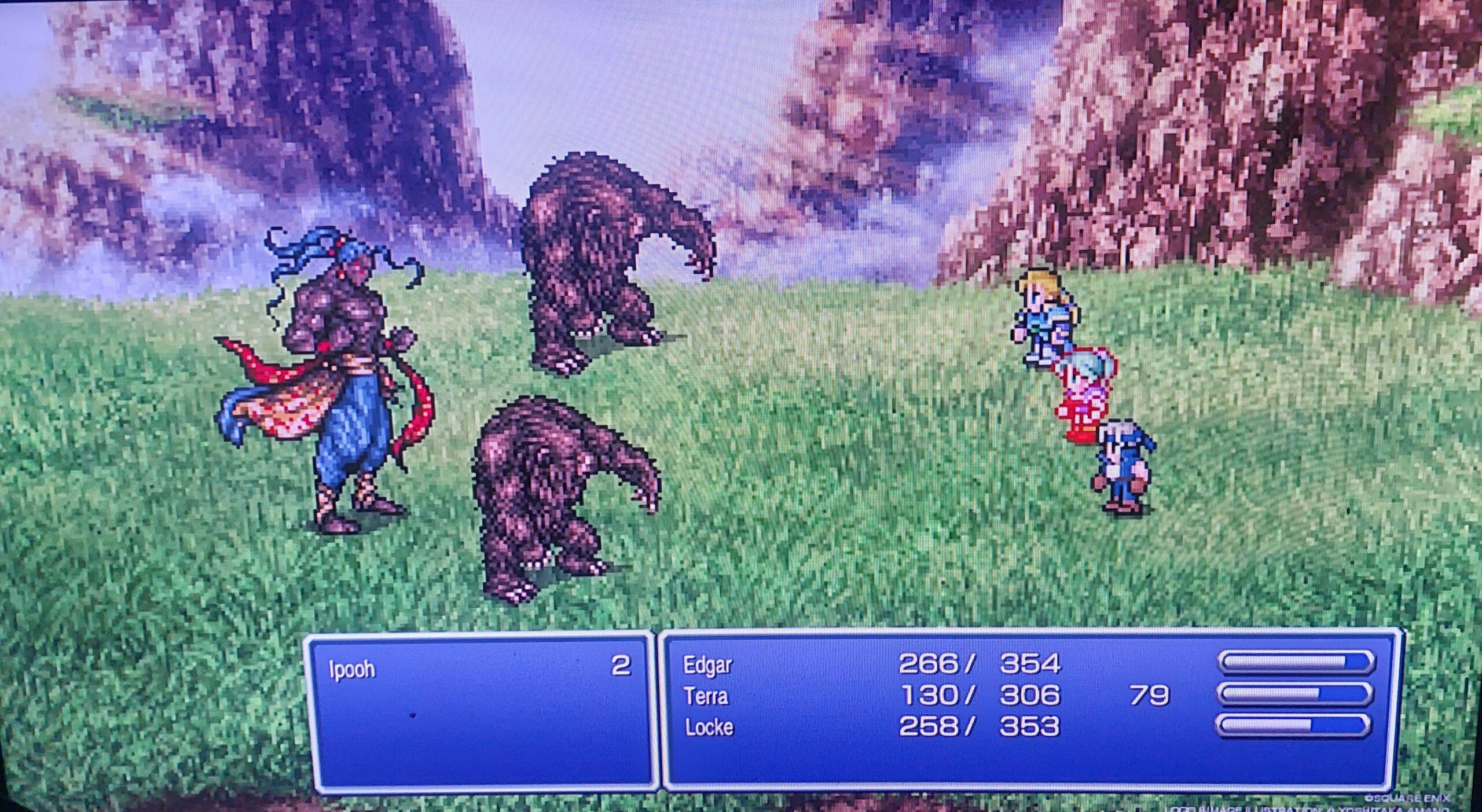
Intro –
The spell list in Final Fantasy VI is vast, and Terra—not to mention Celes—is at the center of those powers, with each one learning her own separate cavalcade of spells. However, after analyzing Terra and Celes’s natural spell lists, I found that many of their spells are level-spaced, for lack of a better term; some aren’t learned until much later levels.
For example, Terra naturally learns Ultima at Level 99, while Celes doesn’t naturally learn Meteor until Level 98. Those are levels where a serious grind could be expected—and not from me, it isn’t. 😂
I was looking at their spell lists a few days ago while playing the game, and it dawned on me that the natural progression of their magic is kind of blah. Yeah, Terra can naturally learn Firaga at Level 43 and Celes can learn Blizzaga at Level 42, but by the time they reach those levels, there’s a good chance I’ll already have opportunities to teach them powerful magic through the Esper system. So, in a way, their natural magic progression becomes a double-edged sword.
That’s one of the reasons the Esper system is so useful: it can shortcut the wait for certain spells. Want Terra to learn Fira earlier? Ifrit can answer the call. Want Celes to learn Blizzara without waiting for her natural progression?
Shiva is more than eager to help. The enemies aren’t going to wait around for Terra and Celes to reach the level required to naturally learn the spell I want, so why should I?
Since I started this replay, I’ve had one goal: make this replay my own. Part of that means teaching Terra and Celes certain powers outside of their natural progression instead of allowing their level-up spell lists to dictate when I’m allowed to use them.
Today, I’m going to explain why I’ve been using Espers to fill the gaps in Terra and Celes’s natural magic progression—and the benefits I’ve been reaping from doing it.
Natural Isn’t Natural, Ironically –
There are spells Terra and Celes can learn that would definitely be useful additions to their arsenals. Thunder magic, for one. I mean, there are so many mechanical enemies throughout the game that having access to Thunder spells could benefit both of them. Poison is another example. I’ve found both an enemy and a boss that were vulnerable to Poison, which really surprised me. Terra eventually learns Graviga naturally, but I’m also interested in experimenting with teaching her Gravity earlier to see how useful it can be before then.
But make no mistake: I don’t plan on using Espers to fill every gap in the girls’ spell lists.
When it comes to Firaga and Blizzaga, I was thinking about letting Terra and Celes learn their respective spells naturally. But since I’m teaching them Thunder magic, I might take the Valigarmanda route and teach them the -aga spells that way. I’m still debating it.
The point is, I’m through waiting until the girls learn certain magic when the game says they can. If an Esper can teach them something sooner and I decide that spell is useful to my strategy, they’re going to learn it sooner. The biggest thing about making this replay my own is drawing my own line instead of letting the game draw it for me.
For me, getting certain spells earlier can change the entire dynamic of what Terra and Celes contribute to battle. There are enemies where elemental weaknesses give me an opening, while powerful non-elemental spells like Flare, Meteor, and Ultima give me another way of dealing damage without having to worry about elemental resistance. Why should I wait until some predetermined level if the Esper system gives me another legitimate path?
The difference between rushing character development and using Espers to fill a weakness lies in where I draw the line. For example, teaching Terra and Celes their -aga spells through Valigarmanda would allow them to cross over into each other’s primary elemental territory: Celes would learn Firaga, while Terra would learn Blizzaga.
In a big way, it’s not as bad as it sounds. On paper, it could potentially dampen their individuality, but I don’t believe it has to. Terra will still have her unique abilities and natural spell progression, just as Celes will still have hers. Teaching Terra one Ice spell because it comes with an Esper I’m deliberately using doesn’t suddenly mean I need to turn around and teach her every Ice spell in the game.
Filling Gaps, Don’t Teach Everything –
Natural progression says that Terra and Celes learn their spells as they climb the level ladder. However, because of the Esper system, Terra and Celes have access to an enormous range of magic—but that doesn’t mean I’m going to teach them everything.
Sure, I can let the girls naturally learn their respective spells, but if an Esper can get me somewhere quicker while giving me a few additional perks along the way, why not ride the wave? The game gives me the option. Even if their natural spell progression suggests waiting, I’m here to play the game, not play ball—and Rodney Lee McGill Jr. doesn’t play ball!
Besides, I do things my way. When it comes to deciding which late-game spells to teach my girls, I don’t look at the Esper system as some cheap shortcut. I base those decisions on opportunity, usefulness, and strategy. By the time I get the opportunity to teach Terra Ultima—which is a big deal for me in this game—the rest of the bosses can stop looking for me and start taking out life insurance policies.
Don’t wait for opportunity to knock. Go kick its door in. I do.
However, I draw the line at unnecessarily teaching the girls each other’s “identity” spells. For example, I’m not going to teach Terra Protect simply because Celes naturally learns it, nor am I going to teach Celes Graviga just because Terra eventually learns it. A spell or two here and there can give the girls some additional versatility, but going so far as to deliberately teach both of them everything the other naturally learns starts bleeding their magical identities together. Eventually, the biggest thing separating them would be their appearance and unique abilities.
That’s why if I see a spell that I know Celes is eventually going to learn and I don’t need it immediately, I don’t necessarily have to use an Esper to fill that gap. I can wait. The same goes for Terra. Just because I’ve decided that I don’t have to follow natural progression doesn’t mean natural progression suddenly has no value.
Terra is already my heavier offensive magic user, and overloading her spell list with everything Celes can do would start diminishing the reason I keep Celes around in the first place. This brings me back to Terra’s Esper form, Trance. It can dramatically amplify Terra’s magical offense, so imagine giving her something like Meteor—a powerful spell she doesn’t naturally learn—and then taking advantage of it while she’s transformed.
Think about that for a moment.
My Shape, My Choice –
The Esper system really did this game wonders—favors, even—because it revolutionized how you can shape the characters you want to use. For example, you don’t necessarily have to wait on Terra and Celes to learn everything naturally. The Espers make it possible to teach them an enormous variety of magic, so you can incorporate the Espers into your strategy and make their power your own by teaching certain spells or simply fast-tracking something you want sooner.
Personally, I didn’t think much about teaching the girls Thunder magic at first, but the more mechanical enemies and other Thunder-vulnerable enemies I encountered, the more useful it started looking. If I’m repeatedly encountering something that’s allergic to Thunder, why wouldn’t I want Terra and Celes capable of exploiting that weakness?
Then there’s Valigarmanda, which teaches the three -aga spells: Firaga, Blizzaga, and Thundaga. Learning these would definitely give the girls another edge, and the more I think about it, the less bothered I am by Celes learning Firaga or Terra learning Blizzaga.
Celes learning Firaga doesn’t suddenly take Fire away from Terra’s identity. Terra still wears that crown as far as I’m concerned. Likewise, Terra learning Blizzaga doesn’t suddenly make her my Ice specialist.
That’s Celes’s territory in the way I’ve chosen to build and view these characters. Crossing that boundary for strategic purposes doesn’t necessarily mean I’ve erased it.
Furthermore, this experiment taught me a valuable lesson about open-mindedness in the name of gaming strategy: closed minds get shut out. I learned that the hard way because I’ve encountered plenty of enemies that were vulnerable to something I could’ve taught the girls sooner. Holding myself to an arbitrary restriction would’ve meant ignoring an advantage the game was openly giving me.
That’s why filling the gaps—and accepting the additional perks that sometimes come with doing it—should be viewed as an advantage rather than some gross miscalculation. Experimenting with the Esper system isn’t destroying my strategy. It’s helping me refine it.
Conclusion –
To wrap up, Terra and Celes are natural magic users who can learn plenty of powerful spells on their own. However, I value the spells they learn naturally because those spell lists help separate them. Terra isn’t going to naturally learn Meteor—that’s Celes’s collar—and Celes isn’t going to naturally learn Ultima—that’s all Terra.
The Espers may have a hand in filling the gaps, but there are still lines I make sure they—or rather, I—don’t cross. If I’m being honest, the natural spell lists for both women shouldn’t dictate when I learn something, especially if it’s something I believe I need right now.
I’ve encountered enemies throughout this replay with weaknesses I could exploit simply by having the right spell available. Having that power on hand can speak volumes, and it’s something FFVI’s open-minded approach to character development allows me to do.
So my advice to you gamers out there is this: make the game yours. Play by your own rules. If you want to use an Esper to teach your girls certain spells earlier, do it; the game gives you that option. And to put a finer point on this, you may end up learning additional spells along the way that you might or might not use, but at least they’ll be there if you eventually decide to.
Embrace it. Let it take you.
For me, I choose when I want to teach my girls certain powers, but I’m not above letting them learn certain spells naturally either. That’s the balance I’ve found during this replay. Sometimes I wait. Sometimes I don’t. What matters is that I’m the one making that decision.
But make no mistake: by the time I reach the World of Ruin, the “venom” of believing I have to obey natural spell progression has worn off. All bets are off. At that point, if teaching the girls additional spells works in my favor without crossing the lines I’ve established for their identities, I’m going to do it.
So remember: play the game your way. Draw your line. Don’t cross it. And above all, shape the game the way you want—not the way you think the game expects you to.
Continue the Adventure
Making an RPG your own isn’t just about following the path the game puts in front of you. It’s about experimenting, finding the strategies that work for you, and enjoying the journey along the way.
I’ve put together a collection of gaming essentials on Benable that can help make those long RPG adventures more comfortable and enjoyable. Check out my recommendations and find something that fits your own gaming setup.
https://benable.com/RoddyMcG/gaming-essentials-for-getting-more-out-of-long-rpg-adventures
Leave a Reply