
Intro –
It can’t be argued that most Final Fantasy games come in from the cold and go out with a bang, and Final Fantasy I Pixel Remaster is no exception.
As someone who just beat the game this morning, I can tell you that there’s far more to this remaster than meets the eye. While it may be a modernized version of a game that originally released in 1987, it still has plenty to offer both longtime fans and newcomers alike.
As the game that started the Final Fantasy franchise, Final Fantasy I laid the foundation for one of gaming’s most celebrated RPG series.
More importantly, the Pixel Remaster gives modern players more control over how they experience that journey through a variety of quality-of-life improvements and gameplay options.
Today, I’m going to discuss what Final Fantasy I Pixel Remaster offers modern players, why it remains relevant after all these years, and what I learned from my own adventure through this classic RPG.
Chapter 1, Simplicity That Still Works –
Now, when you hear the words, ‘straightforward RPG’, you’d think, “yeah right, when has an RPG EVER been straightforward?” Well I can assure that this RPG is definitely.
You remember all those days when you were forced to walk around dungeons trying to find all of the treasure chests while trying to stay alive, it’s like you had three jobs, ironically.
One of the things that make Final Fantasy I Pixel Remaster a slam dunk is that it simplifies dungeon crawling, all of those minutes and hours of trying to find chests or a chest, gone.
You know, it’s like the devs were like, “I know what we thru back in the day, let’s make sure no one else does if they did too.” And with that, we got this nifty little number.


Dungeons being easier, far easier to navigate by simply bringing up the map with the X button.
As someone who just, as I previously mentioned, beat the game, I can tell you that this saved my life many time in every dungeon area I went to.
It’s little perks like this that makes this game not only engaging but gives you the chance to really find and get your footing, it’s a good thing.
So, you know how in the original, you get to choose what you want your party to be. Well, that choice makes a return in this game as well. Incidentally, you can create you own party to be whatever you want.
See, I overlooked this part because if I hadn’t, I would’ve had a Red Mage/Future Red Wizard, A Warrior/Future Knight, A White and Black Mage i.e. Future Black and White Wizards.
But what really gives this flair is that you don’t have to make the first person you start with a Knight or even a Thief, you can make them a Black Mage if you want or a White Mage, it’s all up to you.
The simplest choice given to you and power within the palm of your hand, literally.
Chapter 2, A Classic Made More Accessible –
Another aspect that makes Final Fantasy I Pixel Remaster engaging today is the amount of control it gives the player.
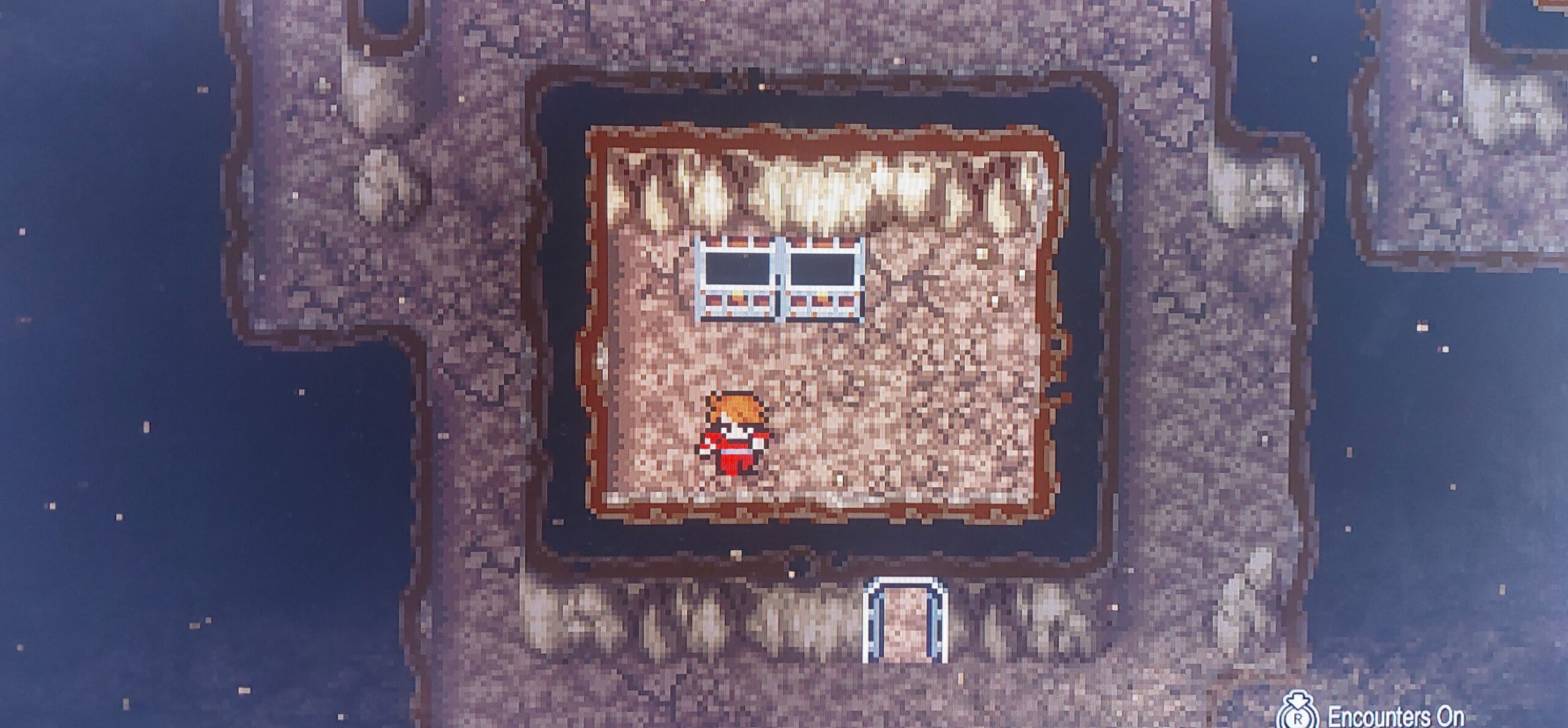
By pressing the R3 button, players can turn random encounters on or off whenever they choose. This feature is especially useful when exploring dungeons and searching for treasure. Trust me, there is plenty of treasure to be found throughout the game’s many dungeons.
What’s great about this feature is that it allows players to decide how much battling they want to do. However, I would advise against abusing it. Random encounters are still one of the primary ways your party gains experience and gil, so balance is key.
The Pixel Remaster also introduces the Boost feature, which allows players to adjust experience and gil gains. If you’re looking to speed things up, setting both to 4x can make a tremendous difference.
I used this setting during my playthrough and found that it removed much of the unnecessary grinding while still allowing me to enjoy the adventure and boss battles.
As a result, the Four Fiends gave me very little trouble throughout most of the game.
The toughest moment I encountered came during my battle with Kraken in the Chaos Shrine of the past, where repeated Thundara spells put pressure on my party. Even then, my team managed to weather the storm.
Chaos himself put up a respectable fight, but thanks to the preparation, levels, and equipment I had accumulated throughout the adventure, I never felt completely overwhelmed.
He made me work for the victory, but it was a challenge I was more than ready to accept.
Perhaps my favorite quality-of-life feature, however, is Quick Save.
In older RPGs, players often felt pressured to finish an entire dungeon in one sitting. Final Fantasy I Pixel Remaster removes that pressure entirely.
If you need to stop playing, you can simply create a Quick Save and return later without losing your progress.
I remember using Quick Save while exploring the Flying Fortress before facing Tiamat.
The next day, I loaded my save and found myself standing right outside her chamber, ready for battle. A few moments later, I was taking the fight directly to her.
Features like these allow Final Fantasy I Pixel Remaster to remain faithful to the original game while giving modern players the flexibility to play on their own terms.
Few RPG remasters I’ve played do a better job of respecting the player’s time while preserving the spirit of the adventure.
Chapter 3, The Birth of A Legend –
Every legend has a beginning, and Final Fantasy I Pixel Remaster gives players a chance to experience where one of gaming’s most celebrated RPG franchises was born.
Getting in on the ground floor of the series allows players to see where many of Final Fantasy’s most recognizable ideas originated.
The party system, character classes, world exploration, airships, and world-saving adventures all have roots that can be traced back to this game.
One thing that surprised me during my playthrough was how quickly the game expands your ability to explore.
Within only a few hours, players gain access to a ship, opening new areas of the world and encouraging exploration.
It serves as an early example of a design philosophy that would become a staple of the franchise: giving players greater freedom as their adventure progresses.
Players will also recognize storytelling concepts that would appear throughout future Final Fantasy titles.
From rescuing important characters to preventing world-ending disasters, many of the themes that define the franchise begin here.
The influence of Final Fantasy I can be felt throughout the series.
Whether it’s helping Terra in Final Fantasy VI, fighting to save the world in Final Fantasy IV, or embarking on Cloud’s journey in Final Fantasy VII, the foundation established here can still be seen decades later.
The airship is perhaps the best example of this influence. What begins as a journey on foot eventually becomes an adventure that spans the entire world.
Once players gain access to the airship, travel becomes faster, exploration becomes easier, and the world suddenly feels much larger. This would become one of the defining traditions of the Final Fantasy franchise.
Final Fantasy I Pixel Remaster didn’t just open the door for future RPGs—it kicked it off the hinges. Many of the ideas that gamers take for granted today can trace their origins back to this adventure, making it just as important to gaming history as it is enjoyable to play.
Chapter 4, The Joy of Exploration –
Most Final Fantasy fans and gamers alike will agree that exploration is one of the most important aspects of the series. Final Fantasy I Pixel Remaster understands this and rewards players who are willing to venture beyond the beaten path.
From the moment you leave the safety of the first town, the game encourages curiosity. What’s beyond that forest? What’s hidden inside that cave? What awaits on the next continent?
The game rarely tells you where you cannot go, and that’s part of what makes exploration so rewarding.
Of course, exploration comes with risks. Wander too far and you may encounter enemies far stronger than your party can handle. But that’s part of the experience.
The game allows players to test their limits and discover for themselves what they are ready to face.
More importantly, exploration often leads to rewards. New treasure chests, stronger equipment, better spells, and entirely new towns are waiting to be discovered.
Every time you set out into the world, there’s a chance you’ll find something that makes your party stronger.
The game’s various forms of transportation, from ships to airships, continually expand the world and give players new reasons to explore.
Suddenly, areas that once seemed unreachable are now within reach, encouraging players to see what secrets the world still holds.
The Cardian Isles are a perfect example. Players who take the time to explore will discover Bahamut and learn things about the world that they otherwise might have missed.
Exploration isn’t just about finding treasure; it’s about uncovering the history and mysteries of the world itself.
I experienced this firsthand when I discovered Lufenia. At first, I had no idea what I had found.
The people spoke a language I couldn’t understand, and I couldn’t immediately benefit from the discovery. Yet finding the town was rewarding because it revealed another piece of the world and its secrets.
Final Fantasy I Pixel Remaster rewards players for being curious. Whether it’s treasure, equipment, new locations, hidden lore, or simply discovering what lies beyond the horizon, the game consistently makes exploration feel worthwhile.
Chapter 5, What the Game Taught Me –
Final Fantasy I Pixel Remaster is not without its lessons to teach. One of the biggest is patience. While it may be tempting to rush through the adventure, the game steadily rewards players who take their time and learn its systems.
As you progress through the game, you’ll encounter stronger enemies that force you to think differently. Raw strength alone isn’t always enough.
Learning enemy weaknesses, understanding which spells are effective, and knowing when to conserve resources can make a tremendous difference.
For me, that meant taking the time to fight enemies throughout each dungeon instead of avoiding them. A little patience goes a long way toward ensuring that your party is prepared when it’s time to face a boss.
Lich is a perfect example. During your first encounter, Light and Dia spells can be extremely effective. Later in the game, different strategies become necessary.
Understanding these weaknesses helps players conserve resources and approach battles more intelligently.
Another lesson the game teaches is that simplicity does not equal weakness.
At the start of the adventure, players choose their party members and are largely free to develop their group as they see fit. There are no complicated skill trees or overwhelming systems to manage.
The magic system reflects this philosophy as well. Players choose which White and Black Magic spells to purchase, allowing them to tailor their party without being buried under dozens of mechanics.
The result is a game that is easy to understand but still rewards thoughtful decision-making.
Final Fantasy I Pixel Remaster proves that a game does not need complex systems to create meaningful strategy. Sometimes patience, preparation, and a solid understanding of the fundamentals are all a player needs to succeed.
Chapter 6, Why Modern Gamers Should Give It A Chance –
With all that said, the question becomes: Who is Final Fantasy I Pixel Remaster for? Longtime fans, newcomers, or both?
Honestly, I think it is for both.
Longtime fans get the opportunity to revisit where the series began while enjoying a number of modern quality-of-life improvements.
At the same time, newer gamers get the chance to experience the foundation upon which one of gaming’s most beloved franchises was built.
If you’re someone who enjoys having control over how you play, this game is absolutely worth a look.
Between the Boost options, encounter settings, straightforward progression, and flexible party creation, players are free to tailor the experience to their liking.
The simplistic game design, rewarding exploration, strategic combat, and sense of adventure all contribute to a game that remains enjoyable decades after its original release.
That’s one of the reasons classics like Final Fantasy I continue to stay relevant. While the game retains its original identity, the Pixel Remaster introduces enough modern conveniences to make it approachable for today’s audience.
Modern gamers can jump in, experience a great RPG, and enjoy the freedom to play it their own way.
Whether you’re returning to the series or discovering it for the first time, Final Fantasy I Pixel Remaster remains an adventure worth taking.
Conclusion –
Final Fantasy I Pixel Remaster may be the beginning of a legendary franchise, but it is far more than a history lesson. It remains a genuinely enjoyable RPG that reminds us why the series became a household name in the first place.
Between its rewarding exploration, strategic combat, straightforward game design, and modern quality-of-life features, the game successfully bridges the gap between classic and modern gaming.
It respects the player’s time while still preserving the sense of adventure that made the original so memorable.
Having recently completed the game myself, I can confidently say that Final Fantasy I Pixel Remaster is not simply a game worth revisiting; it’s a game worth experiencing for the first time if you’ve never played it before.
Whether you’re a longtime fan looking to return to where it all began or a newcomer curious about the origins of the franchise, there’s something here for everyone.
More than anything, Final Fantasy I Pixel Remaster serves as a reminder that great game design never truly goes out of style.
Sometimes all it takes is a party of heroes, a world worth exploring, and an adventure that still knows how to reward curiosity nearly four decades later.
Next: Need a Break After a Long RPG? Here’s the Perfect Palate Cleanser!
If you enjoyed this article, check out my companion Benable list, What Final Fantasy I Still Teaches Modern Players, for games and products that capture the same spirit of adventure, exploration, and classic RPG design:
https://benable.com/RoddyMcG/what-final-fantasy-i-still-teaches-modern-players