Intro –
Valis I is often overlooked when compared to blockbuster franchises like Call of Duty or Star Wars. What many gamers don’t realize, however, is that it’s the kind of experience that makes you appreciate exactly what it sets out to be.
On the surface, it may look like nothing more than a young girl running around with a sword defeating enemies, but there’s much more beneath that simple premise.
Having now beaten the game myself, I found there was a lot to love about the experience—but I’ll get into that shortly. Even after 34 years, Valis I can still provide hours of fun and entertainment.
Don’t let its straightforward presentation fool you. The learning curve is there, and while the game feels approachable, you’ll definitely have to earn your victories.
I come before you today not just as someone who finished Valis I, but as a gamer who can confidently say it remains just as enjoyable today as it was when it was first released.
It still delivers a quality experience and rewards players who approach it with an open mind. In many ways, modern games could take a page from Valis I’s book when it comes to simplicity.
No tutorials. No lengthy explanations of the controls. No lectures about how to use Yuko and her sword. You simply jump in and play.
Simple.
The Hidden Strength of Valis I, Simplicity –
When you think about Valis I, you might expect a game filled with lengthy dialogue and story events before it finally lets you play.
Instead, what makes it so easy to pick up is that it gets straight to the point. You’re not spending the first five minutes trying to absorb tutorials, mechanics, or pages of exposition like many modern games ask you to do.
Valis I has a much simpler message: pick up the controller, step into its world, and start kicking ass. That’s what makes it so inviting. The red carpet of modern gaming expectations simply doesn’t exist here. Like many classic games of its era, the only real expectation is simple: don’t die.
That’s one of the biggest reasons the game resonated with me. It isn’t trying to impress players with endless systems, overpowered weapons, or complicated mechanics.
At its core, it’s about a young girl with a sword trying to make sense of her reality, and the gameplay reflects that straightforward approach.
Another thing I appreciated was that Valis I wasn’t trying to imitate what other games were doing. It created its own identity instead of chasing trends. In many ways, that’s where modern games sometimes stumble—they become so focused on adding more that they forget how effective simplicity can be.
The design revolves around exploring, gaining new abilities, uncovering the story one piece at a time, and learning how to overcome each challenge. That focused approach is what keeps the experience engaging.
Sometimes I wish we could return to the days of games like Valis I, where the focus was simply on gaining new powers, discovering boss weaknesses, mastering your abilities, and relying on quick thinking to succeed.
That’s what made Valis I so enjoyable right from the start. No complicated rhetoric—just great gameplay.
Every Special Weapon Has a Purpose –

One of the best things about Valis I is that you’re not limited to using just your sword. Throughout the adventure, you can enhance it with a variety of special weapons that each offer something different.
While I experimented with all of them, the Hunter quickly became my favorite. Every swing of the sword released seeker projectiles that automatically tracked nearby enemies, making combat feel both satisfying and reliable.
The Hunter became the only special weapon I used from beginning to end, and I had two reasons for making that decision.
First, I wanted to challenge myself. I wanted to see if I could complete the entire game using the weapon I enjoyed the most instead of constantly switching between abilities. Fortunately, that challenge paid off.
Second—and more importantly—the Hunter fit the way I wanted to play. I wasn’t looking for the easiest route through the game. I wanted a weapon that could handle almost every situation despite whatever weaknesses it might have.
The Hunter did exactly that. It reduced surprise attacks, kept enemies under control, and made boss battles feel more manageable without removing the challenge.
Even though I eventually settled on the Hunter, I did experiment with every special weapon, including the Arc Shot and the Saber.
They all have their strengths, but the Hunter simply suited my playstyle better. As it became stronger, enemies were less likely to catch me off guard, and boss fights became much smoother.
Another feature I really appreciated was that defeating bosses rewarded you with new abilities. My favorite by far was the Rune Barrier. Its defensive capabilities proved incredibly useful whenever I found myself in trouble.
While it required a moderate amount of magic to use, that was a small price to pay when I needed extra protection or simply wanted more time to study a boss’s attack patterns before going on the offensive.

Valis I, Short but Memorable –
Taking my time to explore and enjoy the experience, I finished Valis I in about 18 in-game hours. Even the final battle, despite having two phases, didn’t take nearly as long as I expected.
The only part that really slowed me down was learning Rogles’ attack patterns, and even that took less than ten minutes once I settled in and paid attention.
Modern games often try to give players the most bang for their buck by stretching the experience with larger worlds, longer campaigns, and countless side activities.
There’s nothing inherently wrong with that, but Valis I proves you can still get tremendous value from a shorter adventure. A focused game can leave a lasting impression without demanding dozens of hours of your time.
In fact, I’d argue that long games are more likely to consume your available playtime than a shorter game is to disappoint your wallet. Think about that for a second.
What really sold me on Valis I was its focus. It never tried to pad the adventure with unnecessary endgame filler or distract players with puzzles that pulled attention away from the action.
Everything revolved around Yuko’s mission to save both worlds. Rogles’ lieutenants appeared, challenged you, and once they were defeated, the adventure kept moving. There were no unnecessary detours—just a clear objective from beginning to end.
Valis I proves that a game’s length isn’t what makes it memorable—its quality does. That’s also one of the reasons it’s worth replaying. You can experiment with different special weapons instead of following the path I chose, use it as the perfect palate cleanser after a long RPG, or simply enjoy the freedom to play at your own pace.
Thanks to the save system, you never feel pressured to finish everything in one sitting. You decide when to stop and when to continue, and that control makes returning to the game even more enjoyable. can stop wherever, even during boss battles. You have the control.
Observation vs. Panic, The Boss’s Reward –
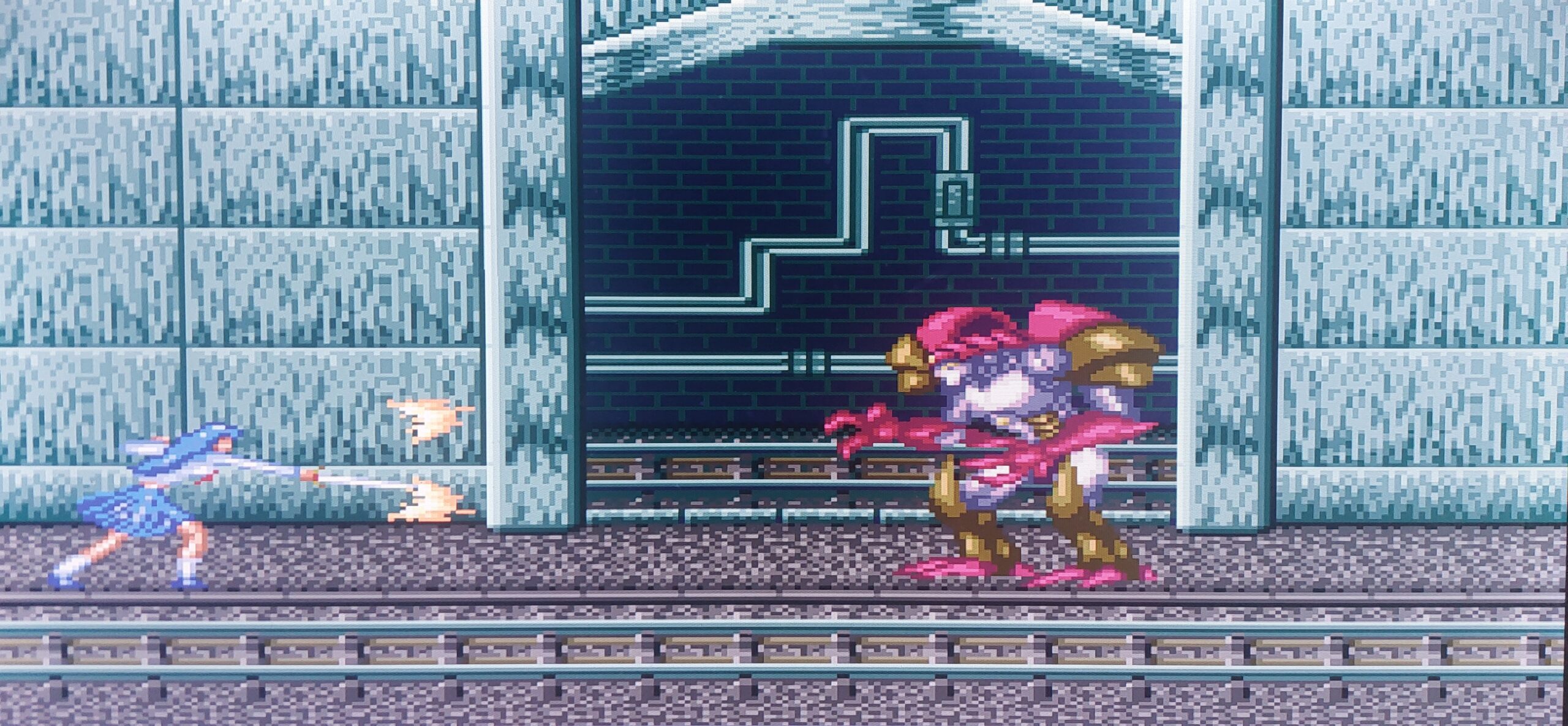
The boss that challenged me the most was, ironically, the final boss himself—Rogles. His attack patterns weren’t especially complicated, but he definitely made me earn the victory.
There were several moments where I nearly got caught because I was constantly watching his movements, deciding when to dodge, when to slide, and when to stay out of range. Success wasn’t about attacking nonstop—it was about reacting correctly to everything he did.
When Rogles entered his second form, it felt like he had changed his strategy. Even so, most of his attacks were readable once I paid close attention. He spent much of the fight darting through the air before positioning himself to swing his mace.
The key was sliding underneath him as he landed, keeping yourself just outside the reach of that attack before immediately going back on the offensive.
It was a demanding battle, and without Rewind I probably would’ve died a couple of times. Even so, I never felt like I needed endless patience. I simply needed to understand what the fight was asking me to do.
I’ve always been the type of gamer who reads boss patterns during the battle instead of stopping to study them afterward. For me, victory comes from recognizing what to watch for rather than simply landing as many hits as possible.
With Rogles, once I realized he almost always swung his mace immediately after landing from one of his aerial dashes, I knew exactly how to react depending on where he landed.
By the end of both phases, Rogles had definitely given me a run for my money. He was easily the toughest boss in the game, but he also perfectly demonstrated what makes Valis I’s boss fights so satisfying: they reward observation, adaptation, and good timing far more than blind aggression.
Valis I Reminded Me Why I Love Classic Action Games –
I can’t say there was one specific moment that made me appreciate classic action games again—it was really the entire experience. When you stop and think about what makes the genre so enjoyable, Valis I checks all the right boxes.
That’s why I believe it’s such an underrated hidden gem. In many ways, it belongs in the same conversation as classics like Contra, Super Mario Bros., and The Legend of Zelda.
The controls felt responsive, the pacing was excellent, and by the time I reached the ending, I honestly felt like I could’ve started another playthrough right away. That’s the sign of a game that leaves a lasting impression.
I also appreciated how the cutscenes gave just enough story to keep me invested without interrupting the flow of the action. They helped explain what was happening and where Yuko’s journey was headed without overstaying their welcome.
That’s one of the reasons classic action games continue to be enjoyable years after their release.
They focus on what matters most: solid gameplay, responsive controls, and a clear objective. Instead of constantly stopping to teach you another mechanic or overwhelming you with unnecessary complexity, they trust you to pick up the controller and simply play.
For me, that’s a big part of why games like Valis I remain so rewarding decades later.
Valis I is Still Playable In the Present Day –
To conclude, based on my experience, I’d recommend Valis I to anyone who enjoys anime or appreciates action games that don’t overstay their welcome. I’d especially recommend it to players who’ve never heard of the series before. It’s one of those games that quietly earns a place in your collection because it’s memorable, focused, and simply fun to play.
One of the biggest surprises for me was its length. I expected each stage to have multiple sub-levels like later entries in the series, but Valis I took a much more direct approach. Instead of filling the adventure with unnecessary padding, it stayed focused on delivering solid gameplay from beginning to end.
Between the special weapons, boss abilities, and opportunities to develop your own strategy, I never felt like the experience was lacking despite its shorter runtime.
Some people may look at a 34-year-old game and assume it has nothing left to offer when compared to titles like Ninja Gaiden Sigma, Elden Ring, or Crash Bandicoot.
I couldn’t disagree more. Valis I still has its own identity. It may not overwhelm players with massive worlds or endless mechanics, but it delivers a rewarding experience that feels complete from beginning to end.
The biggest lesson I learned from Valis I is that great game design doesn’t have to be complicated. It doesn’t rely on unnecessary distractions or artificial padding to keep players engaged.
Instead, it trusts its straightforward gameplay, responsive controls, and rewarding mechanics to carry the experience. More than three decades later, that’s exactly why Valis I still holds up today.den Sigma, Elden Ring even Crash Bandicoot.
The game still comes with its own bag of tricks, nothing too out of the ordinary but enough where you know that you’re getting something of value without feeling like you’re getting cheated because the game is short but to the point.
The main lesson I learned while playing Valis I is being able to appreciate the game design as it is, its not fluffed up or have landmarks where you can’t get ambushed or take a significant amount of damage but you’re able to destroy everything in a straightforward manner.
If Valis I sounds like the kind of classic action game you’d enjoy, I’ve also put together a Benable list featuring modern ways to play it along with other games and products I recommend.
Check out my Benable list to see what made the cut and discover more hidden gems worth adding to your collection. https://benable.com/RoddyMcG/hidden-action-games-worth-your-time