Intro –
My first impression of Valis III was, and I quote, “Kind of blah.” Mainly, that was because I expected it to play more like Valis I and Valis IV—fast-paced action, powerful armor, and abilities capable of wiping out hordes of enemies in an instant.
However, that opinion quickly changed after I spent a couple of levels with the game. Valis III is incredible in its own right. I say that because after spending some time with it, the game doesn’t apologize for being a little underwhelming at first. In fact, that’s where the surprise lies.
I started the game with no real expectations because I knew every entry in the series was different. But after playing through a stage or two, I realized I didn’t want to put the controller down. The game was that addictive.
Not because it was some simple afternoon conquest, but because its mechanics make it so easy to dive right into the action. The item boxes contain different types of magic that you can use to overcome obstacles or simply experiment with, and that sense of discovery became one of my favorite parts of the experience.
I think that’s one of the things that separates Valis III from many other action games. You never really know what you’re going to experience until you’re neck-deep in the adventure. Then the game throws another surprise at you by allowing you to play as two additional heroines besides Yuko.
Each one changes the gameplay in meaningful ways, making you wonder, “What can she do?” or “Wow, I really like the way her weapon works.” Features that might not seem important on paper become exciting once you’re actually playing, and that’s part of what makes the game so enjoyable.
Personally, after spending time with Valis III, it reminded me of other games that hook players almost immediately. Ninja Gaiden Sigma 2 comes to mind. The action begins almost the moment you take control, and Valis III creates a similar feeling. You don’t spend long waiting for the excitement to begin because the game gets you involved almost immediately.
That’s exactly what I’m here to talk about today—why Valis III is so easy to get into and even harder to put down.cond the game drops right in and that’s how Valis III is and you can appreciate not having to wait on when the action is going to hit the fan. I’m here today to bring to you why Valis III is so easy to get into and not want to stop,
Why Valis III Respects the Player’s Time –
One of the things I love about Valis III is that it doesn’t waste time dropping you right into the action. Shortly after reclaiming the Valis Sword, the rest of the game opens up, placing you in the heart of each stage.
From there, you’re introduced to item boxes containing everything from Magic Point refills and Hearts to 1-Ups and powerful spells. Even though Fire Magic is the only spell available at the beginning, it’s still more than enough to bring Glames to his knees during your first encounter with him.
Throughout the game, I never felt like I had to wait for it to become enjoyable because I was constantly discovering little details about each stage. After recovering the Valis Sword, enemies began appearing more frequently, but not to the point where I felt overwhelmed. The game gives you enough breathing room to explore before the next encounter begins.
That balance is one of the reasons the pacing works so well. While the difficulty certainly increases, learning your moveset and taking advantage of the Rewind feature helps you improve instead of feeling punished for every mistake.
The pacing of Valis III is one of its greatest strengths. The stages are relatively short, but they’re packed with enough variety that they never feel rushed or repetitive. Each level introduces new situations, different magic, and fresh challenges that encourage you to think about the best tool for the job.
There were plenty of moments when I didn’t want to stop playing simply because I had figured out a clever way to overcome an obstacle, and I wanted to see what the next stage had in store.
A perfect example comes from Sutherland (Stage 5). I found myself facing chasms that were too wide to jump or slide across. Instead of expecting impossible precision, the game provides Ice Magic, allowing you to freeze enemies and use them as platforms to cross safely. Valna is especially useful during this stage.
That’s what I mean when I say Valis III respects the player’s time. It introduces a mechanic, gives you an opportunity to understand it, lets you use it effectively, and then moves on to the next idea.
The stages never feel bloated with unnecessary filler or stretched out simply to make the game longer. Valis III knows exactly how much to give the player before moving forward, and that balance keeps the experience engaging from beginning to end.
The Gameplay Is Addictive –
The game’s most addictive quality is how it combines sword combat and magic into a single fighting style. For example, when you’re using Fire Magic as Yuko against an enemy or boss, the magical swords continue dealing damage while you’re attacking with the Valis Sword at the same time.
Watching both forms of offense work together makes combat feel fast, satisfying, and rewarding.
I have to admit, it caught me by surprise when I saw how each magic spell worked because every one of them serves a different purpose. While it could be argued that the game becomes a little repetitive after a few stages, Valis III does an excellent job of keeping things fresh.
Take Els Forest (Stage 3) for example. You’re suddenly fighting crimson enemies that are nearly invisible while carrying spears, followed shortly afterward by giant flying jaws.
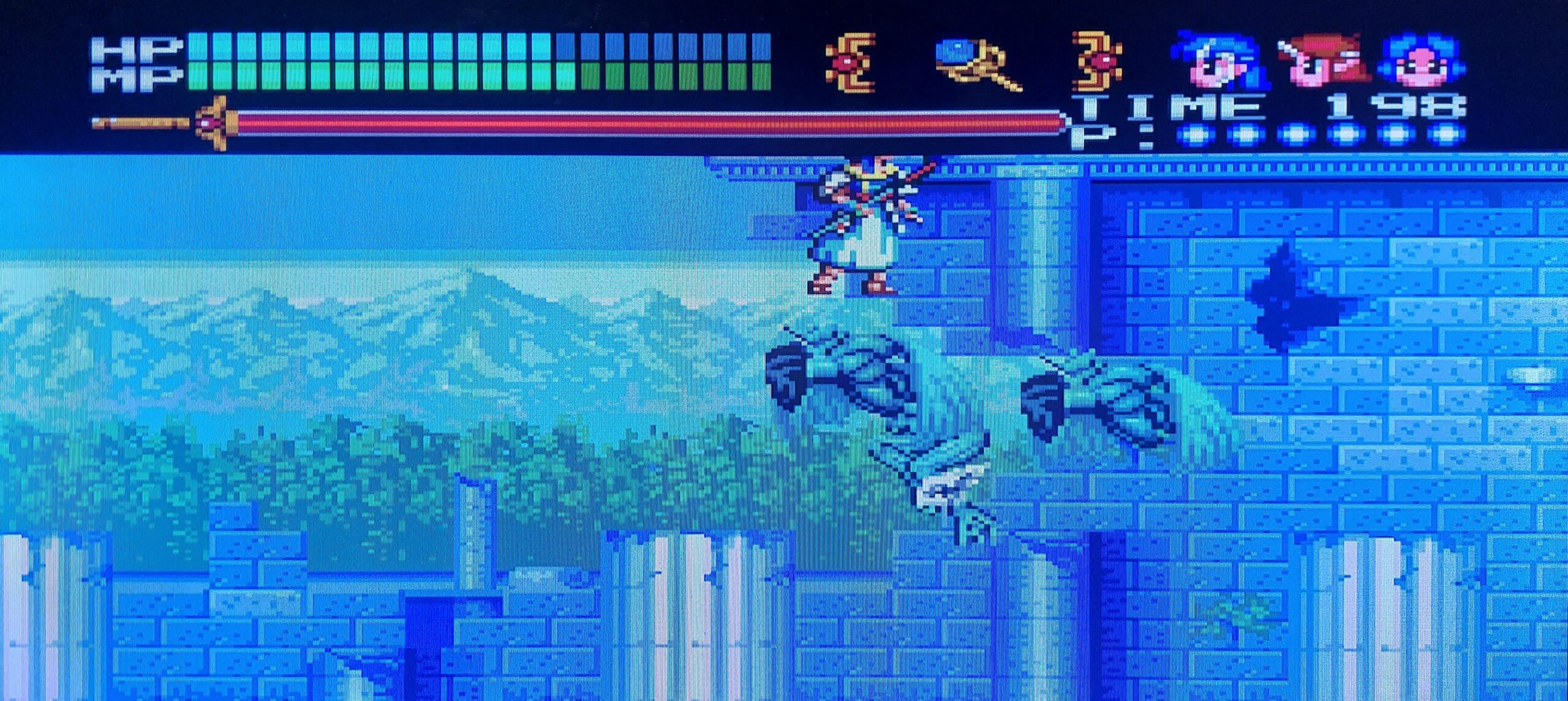
Then, in Glames’ Tower (Stage 4), you’re dealing with heavily armored sentries whose sword attacks hit incredibly hard. I hated those jerks, but they forced me to change my approach. Instead of charging straight at them, I relied on Cham’s abilities to climb the tower and keep my distance whenever possible.
Ironically, climbing the tower wasn’t nearly as frustrating as making my way through Sutherland (Stage 5), where I constantly had to fight against the rushing water to avoid being knocked into the pits below.
Every stage introduces what I like to call its own little “puzzle.” In Sutherland, you’re figuring out how to cross wide chasms. In Stage 2, you’re learning how to reach areas you can’t simply jump across.
In Stage 7, you’re trying to avoid sinking into quicksand. Those mechanics keep you pushing forward because every time you solve one challenge, another interesting obstacle is waiting just ahead. Even something as simple as enemies dropping Hearts to restore your health encourages you to stay in the fight instead of giving up.
I also think the Rewind feature is one of the reasons the game is so difficult to put down. Every death and every mistake feels like something you can learn from instead of something that permanently sets you back.
Rather than punishing failure, the game encourages experimentation and improvement. It puts control in the player’s hands and gives you the freedom to keep trying different approaches until you succeed.
It’s no wonder I kept saying, “Just one more stage.” Before I knew it, one stage turned into two, and two turned into another twenty-five minutes of gameplay. Valis III constantly gives you something to anticipate. Whether it’s the next boss, a strange new enemy, or another magic spell to experiment with, the surprises keep coming. That’s exactly what makes the game so addictive.
The Challenge Never Felt Like Frustration –
Valis III stays challenging without becoming overwhelming because it never relies on simply throwing endless enemies at the player. Sure, some of the enemies can be a little over the top, but finding a way through each encounter is part of the fun.
I enjoyed experimenting with different types of magic or discovering strategies that made certain situations much easier to handle. That’s one of the things I appreciate most about the game—it gives you the tools to take control of the challenge instead of making you feel helpless.
Enemy patterns are another reason the challenge never became frustrating. I remember one boss in particular—I believe it was the Stage 2 boss. Most of the fight consisted of him talking trash before zipping around the screen while I patiently waited for the right opening to attack.
His pattern was surprisingly easy to learn, and once I understood it, the battle became much more manageable. That’s what I enjoy about boss fights built around recognizable attack patterns. Even if I lose a few times, every attempt teaches me something new, and eventually that knowledge becomes the key to victory.
Valis III also rewards patience and observation. Keeping an eye on your sword meter allows you to unleash its powerful wave attack at just the right moment, maximizing your damage against both regular enemies and bosses.
Learning when to switch between Yuko and the other two heroines also adds another layer of strategy. Those mechanics kept me engaged because I always felt like the game was giving me the tools I needed to succeed. Victory never felt impossible—it simply required paying attention, learning the mechanics, and applying them when the time was right.
Why Is Simplicity One of Valis III’s Greatest Strengths?
Valis III knows how to deliver an exciting experience without overwhelming the player, and it accomplishes that by keeping everything simple. You enter a stage with your sword drawn, defeat enemies, collect items from treasure boxes, and continue progressing through the level.
Eventually, you reach a boss, learn its attack pattern, develop a strategy, defeat it, and move on. There are no overly complicated objectives or constant backtracking.
The gameplay remains focused on what it does best—fast-paced action with straightforward mechanics. That’s one of the reasons I appreciate Valis III so much. It reminds me that simplicity isn’t a weakness; it’s one of the game’s greatest strengths.
Even the modern conveniences, like the Rewind feature and the ability to save whenever you want, don’t replace what already makes the game enjoyable.
Instead, they enhance the experience by reducing unnecessary frustration while preserving the original gameplay. That’s an important distinction because those features don’t make Valis III a great game—they simply make an already great game even more accessible.
One of the things I admire most about Valis III is its confidence. The game doesn’t try to overwhelm you with countless mechanics or systems. It introduces its ideas gradually, gives you time to understand them, and then lets you enjoy mastering them.
I paid very little for the game, yet I got the same feeling of satisfaction that I’ve experienced with much larger titles like Chrono Trigger or Ninja Gaiden 3: Razor’s Edge. That’s proof that a game’s value isn’t measured by its size or complexity but by how enjoyable the experience is.
Ultimately, Valis III demonstrates that great game design doesn’t have to be complicated. It rarely throws more at the player than they can reasonably handle, and the difficulty increases naturally instead of relying on sudden spikes.
The result is a game that’s approachable without becoming boring and challenging without becoming frustrating. That’s the kind of simplicity I believe more games could learn from.city.
Why Did I Keep Coming Back For More?
Over the last couple of days, I’ve been working my way through Valis III, and honestly, there were several times when I didn’t even want to stop playing, even though I knew I needed sleep. Why? Because I became completely engrossed in the game. I kept wanting to know what was going to happen next.
Whether it was the next stage, the next boss, or the next piece of the story, my curiosity kept pulling me forward. The game never made me feel rushed, yet it always gave me a reason to continue. There wasn’t a constant sense of urgency, but there was always enough mystery to make me say, “Just one more stage.”
Completing each level only strengthened that feeling. Every stage I finished made me feel like I was getting closer to understanding what was happening and why everything had become such an emergency.
At the same time, I always felt like the game was hinting that Yuko’s true power had yet to be revealed. That combination of curiosity and progression kept me completely invested in the adventure.
One of the things that kept me engaged was the freedom to approach battles using my own strategies. The game never forced me into a single solution by saying, “You have to use this magic to win.”
Instead, it gave me the tools and allowed me to decide how I wanted to overcome each challenge. That freedom made every victory feel like my own rather than the result of following a predetermined strategy.
By the time I reached the later stages, I realized Valis III had done something that only a handful of games manage to accomplish—it consistently made me want to see what was around the next corner. Whether it was another boss, a new spell, or the next chapter of the story, the game always gave me another reason to keep playing. That’s exactly why I found it so difficult to put the controller down.
Conclusion –
To wrap things up, Valis III reinforced my belief that great games don’t have to be complicated to keep players engaged. One of the biggest reasons I enjoyed the game so much was its simplicity.
You have a variety of magic abilities that complement different playstyles, while the boss battles feature attack patterns that are easy to learn and encourage you to develop your own strategies.
There’s nothing overly complicated about fighting your way through the game. It’s simply you, your sword, your companions, and whatever challenge lies ahead.
Speaking of companions, each heroine brings her own strengths to the adventure, giving you a reason to think about which one best fits the situation. Valna excels at long-range attacks, Cham is excellent in medium-range combat, and Yuko provides a balanced approach.
Combined with the game’s excellent pacing, you’re always given just enough information and gameplay to make you want to keep moving forward. After each boss battle, the story reveals another piece of the adventure, giving you another reason to see what happens next.
What impressed me most about Valis III is how naturally it encourages you to come back for one more stage. Much like classics such as Super Mario Bros. 3 and Contra: Operation Galuga, the game knows exactly how long it should be.
It never feels stretched out, nor does it end before it’s ready. Everything about the experience feels deliberate, and that’s one of the reasons it remained enjoyable from beginning to end.
Despite being more than three decades old, Valis III still deserves to be played today. It offers engaging gameplay, memorable level design, and a pace that provides a welcome break from many of today’s larger, more demanding games.
It doesn’t rely on flashy presentation or endless mechanics to impress the player. Instead, it succeeds by doing the fundamentals exceptionally well.
I hope you’ll give Valis III a chance—not simply because it’s a remastered classic, but because it’s proof that great game design never goes out of style. If you’re looking for an action game that’s easy to get into, difficult to put down, and respectful of your time, Valis III deserves a place in your collection.
Continue the Adventure
If you enjoyed reading about why Valis III is so easy to get lost in, I’ve put together a Benable list featuring more action games that are just as difficult to put down. Whether you’re looking for classic adventures or modern action titles, you’ll find plenty of recommendations to continue your gaming journey.
https://benable.com/RoddyMcG/classic-action-games-that-are-impossible-to-put-down
Leave a Reply